Upbeat Trump welcomes U.S. prisoners released by North Korea

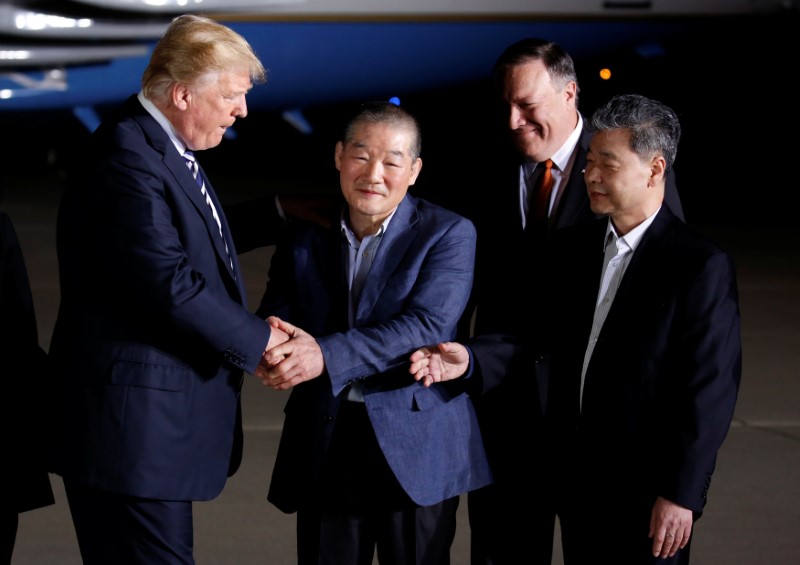
U.S.President Donald Trump greets the Americans formerly held hostage in North Korea upon their arrival at Joint Base Andrews, Maryland, U.S., May 10, 2018. REUTERS/Joshua Roberts

By Roberta Rampton and David Brunnstrom

JOINT BASE ANDREWS, Md./WASHINGTON (Reuters) – President Donald Trump welcomed three Americans who had been held prisoner in North Korea back home on Thursday, thanking its leader Kim Jong Un for their release and sounding upbeat about a planned U.S.-North Korea summit.

The former prisoners, freed after U.S. Secretary of State Mike Pompeo traveled to Pyongyang for a second meeting with Kim in less than six weeks, landed at around 2:40 a.m. (0640 GMT) at Joint Base Andrews near Washington.

Trump and his wife, Melania, boarded the plane for about five minutes before the three men stepped out, shaking hands with the president and waving to media and military personnel.

“Frankly, we didn’t think it was going to happen and it did,” Trump said after thanking Kim for releasing the men.

“We’re starting off on a new footing. This is a wonderful thing that he released the folks early.”

Trump said he believed Kim wanted to bring North Korea “into the real world” and had high hopes for their planned meeting, which would be the first between a serving U.S. president and a North Korean leader.

“I think we have a very good chance of doing something very meaningful,” Trump said. “My proudest achievement will be – this is part of it – when we denuclearize that entire peninsula.”

Trump and Kim engaged in a bellicose exchange of rhetoric last year over North Korea’s development of nuclear missiles capable of reaching the United States. Tensions began to ease, coinciding with the North’s participation in the Winter Olympics in South Korea in February.

There has been no sign that Pompeo’s visit has cleared up the central question of whether North Korea will be willing to bargain away weapons its ruling family has long seen as crucial to its survival.

However, the release of the three men marked a dramatic victory for Trump’s embattled White House at a time when his foreign policy is under withering criticism after Tuesday’s U.S. withdrawal from the Iran nuclear deal.

His administration has also been under fire for ethics violations and a chaotic turnover of personnel, as well as a federal investigation of whether the Trump campaign colluded with Russia to sway the 2016 presidential election.

The three Americans formerly held hostage in North Korea gesture next to U.S.President Donald Trump, upon their arrival at Joint Base Andrews, Maryland, U.S., May 10, 2018. REUTERS/Jim Bourg

The three Americans formerly held hostage in North Korea gesture next to U.S.President Donald Trump, upon their arrival at Joint Base Andrews, Maryland, U.S., May 10, 2018. REUTERS/Jim Bourg

MADE-FOR-TV MOMENT

The arrival of the released prisoners in the dead of night created a made-for-TV moment for Trump, a former reality television host.

“I think you probably broke the all-time-in-history television rating for three o’clock in the morning,” Trump joked to cameras.

Details of the planned Trump-Kim summit have yet to be announced, but a U.S. official, speaking on condition of anonymity, said Singapore had emerged as the likeliest location.

Trump said it would be held in a few weeks and details would be announced within three days.

The three former prisoners were Korean-American missionary Kim Dong-chul, detained in 2015 and sentenced in 2016 to 10 years’ hard labor; Kim Sang-duk, also known as Tony Kim, who taught for a month at the foreign-funded Pyongyang University of Science and Technology (PUST) before he was arrested in 2017; and Kim Hak-song, who also taught at PUST and was detained last year.

They appeared to be in good health but were taken to Walter Reed National Military Medical Center in nearby Maryland for further medical evaluation.

“I was treated in many different ways, but overall I had to do much labor and when I became ill I received some treatment,” Kim Dong-chul said via a translator.

The trio thanked Trump and other officials for bringing them home. “We thank God, and all our families and friends who prayed for us and for our return,” they said in a statement released as their plane made a stop in Alaska.

Until now, the only American released by North Korea during Trump’s presidency was Otto Warmbier, a 22-year-old university student who returned home in a coma last summer after 17 months in prison and died days later. His death escalated U.S.-North Korea tensions.

Trump said he wanted to pay his “warmest respects” to Warmbier’s parents.

North Korean state media said the three were arrested either for subversion or “hostile acts” against the government. A North Korean official told Pompeo that Kim had granted the three “amnesty,” a senior U.S. official said.

‘NO CLARITY’

The release appeared to signal an effort by Kim to improve the mood for the summit and followed a recent pledge to suspend missile tests and shut a nuclear bomb test site.

Trump has credited his “maximum pressure” campaign for drawing North Korea to the table and vowed to keep sanctions in place until Pyongyang takes concrete steps to denuclearize.

But former spy chief Kim Yong Chul, director of North Korea’s United Front Department, said in a toast to Pompeo over lunch in Pyongyang: “We have perfected our nuclear capability. It is our policy to concentrate all efforts into economic progress … This is not the result of sanctions that have been imposed from outside.”

Bonnie Glaser, an Asia expert at Center for Strategic and International Studies, said that while the release of the detainees was not an explicit precondition for a Trump-Kim meeting, the North Koreans understood that they had to do it for any progress to be made.

“The North Koreans have still said nothing to indicate that they are willing to give up their nuclear weapons” she said.

“We have no clarity about Kim’s intentions.”

Vice President Mike Pence echoed that caution, even while praising Kim for making moves toward peace.

“What Kim Jong Un has said publicly and in discussions is that he is prepared to negotiate to achieve complete denuclearization of the Korean Peninsula,” Pence told the CBS “This Morning” program on Thursday. “Those words are important, but we’ll see what they mean.”

A land divided – https://tmsnrt.rs/2KdXMcS

American detainees in North Korea – http://tmsnrt.rs/2pmE3ks

(Additional reporting by Steve Holland in WASHINGTON; Haejin Choi and Christine Kim in SEOUL; Brendan O’Brien in Milwaukee; Writing by Lincoln Feast; Editing by Nick Macfie and John Stonestreet)

North Korea releases detained Americans ahead of anticipated Trump-Kim summit

FILE PHOTO: A combination photo shows Mike Pompeo (L) in Washington, North Korean leader Kim Jong Un (C) in Pyongyang, North Korea and U.S. President Donald Trump (R), in Palm Beach, Florida, U.S., respectively from Reuters files. REUTERS/Yuri Gripas (L) & KCNA handout via Reuters & Kevin Lamarque (R)

By Makini Brice and Susan Heavey

WASHINGTON (Reuters) – U.S. President Donald Trump said on Wednesday that three Americans detained by North Korea have been released and are on their way home with Secretary of State Mike Pompeo.

Trump said he will greet Pompeo and the Americans when they land at Andrews Air Force Base outside Washington at 2 a.m. EDT (0600 GMT) Thursday morning.

“I am pleased to inform you that Secretary of State Mike Pompeo is in the air and on his way back from North Korea with the 3 wonderful gentlemen that everyone is looking so forward to meeting. They seem to be in good health,” Trump wrote in a post on Twitter.

South Korea heralded the move as positive for upcoming talks between Trump and Kim and called on Pyongyang to also release six South Korean detainees.

Pompeo had arrived in the North Korean capital, Pyongyang, earlier on Wednesday from Japan and headed to its Koryo Hotel for meetings.

The three U.S. detainees being released are Korean-American missionary Kim Dong-chul; Kim Sang-duk, also known as Tony Kim, who spent a month teaching at the foreign-funded Pyongyang University of Science and Technology (PUST) before he was arrested in 2017; and Kim Hak-song, who also taught at PUST.

Until now, the only American released by North Korea during Trump’s presidency has been Otto Warmbier, a 22—year-old university student who returned to the United States in a coma last summer after 17 months of captivity. He died days later.

Warmbier’s death escalated U.S.-North Korea tensions, already running high at the time over Pyongyang’s stepped-up missile tests.

The upcoming U.S.-North Korea summit has sparked a flurry of diplomacy, with Japan, South Korea and China holding a high-level meeting in Tokyo on Wednesday.

However, North Korea reminded the United States on Wednesday there still was tension between them, warning it against “making words and acts that may destroy the hard-won atmosphere of dialogue,” the North’s state media said.

“The U.S. is persistently clinging to the hostile policy toward the DPRK, misleading the public opinion. Such behavior may result in endangering the security of its own country,” it added, referring to the North’s official name, the Democratic People’s Republic of Korea.

(Reporting by Makini Brice and Susan Heavey; Additional reporting by Ju-min Park and Christine Kim in Seoul; Writing by Josh Smith; Editing by Paul Tait and Bill Trott)

Trump says Pompeo en route to North Korea, cites hopes on U.S. detainees

FILE PHOTO: U.S. Secretary of State Mike Pompeo listens to remarks made by President Donald Trump during Pompeo's swearing-in ceremony at the Department of State in Washington, U.S., May 2, 2018. REUTERS/Leah Millis

By Matt Spetalnick and Lesley Wroughton

WASHINGTON (Reuters) – President Donald Trump revealed on Tuesday that U.S. Secretary of State Mike Pompeo was on his way to Pyongyang to prepare for Trump’s summit with North Korean leader Kim Jong Un and expressed hope that three Americans held there would soon be released.

Trump said Pompeo, making his second visit to North Korea in less than six weeks, was expected to arrive “very shortly” and that the two countries had already agreed on a date and location for the unprecedented summit, though he stopped short of providing details.

While Trump said it would be a “great thing” if the three American detainees were freed, Pompeo, speaking to reporters en route to Pyongyang, said he had not received a commitment for their release but hoped North Korea would “do the right thing.”

Their release could signal an effort by Kim to set a more positive tone for the summit following his recent pledge to suspend missile tests and shut Pyongyang’s nuclear bomb test site.

While Kim would be giving up the last of his remaining American prisoners, whom North Korea has often used in the past as bargaining chips with the United States, a release could also be aimed at pressuring Trump to make concessions of his own in his bid to get Pyongyang to abandon its nuclear arsenal, something it has not signaled a willingness to do.

“Plans are being made, relationships are building,” Trump said of the planned summit during remarks at the White House that were otherwise focused on his decision to pull the United States out of the 2015 Iran nuclear deal.

“Hopefully, a deal will happen. And with the help of China, South Korea and Japan, a future of great prosperity and security can be achieved for everyone,” Trump added.

Pompeo made a secret visit to North Korea over the Easter weekend, becoming the first U.S. official known to have met Kim, to lay the groundwork for the planned summit. The meeting occurred before Pompeo’s nomination as secretary of state had been confirmed.

Trump suggested that dropping out of the Iran nuclear accord, which he has frequently denounced as a bad deal for the United States, would send a “critical message” not just to Tehran but also to Pyongyang. He has demanded that North Korea agree to give up its nuclear arsenal.

“The United States no longer makes empty threats. When I make promises, I keep them,” Trump said.

FATE OF THREE DETAINEES IN PLAY

Pompeo’s latest trip raised the prospects that the three Korean-American detainees – Kim Hak-song, Tony Kim and Kim Dong-chul – could be turned over to him.

Asked whether that could happen, Trump told reporters: “We’ll all soon be finding out. We’ll soon be finding out. It would be a great thing if they are.”

“We’ve been asking for the release of these detainees for 17 months,” Pompeo said. “We’ll talk about it again. It’d be a great gesture if they’d agree to do so.”

Pompeo said he was hoping to finalize the agenda for the summit. He met Kim on this last trip but said he did not know exactly who he would meet this time.

Pompeo said he hoped to be able to outline a set of conditions that would create the opportunity for a historic change in the security relationship with North Korea and added that sanctions would not be lifted until U.S. objectives were met.

“We are not going to head down the path we headed down before,” he said. “We will not relieve sanctions until such time as we have achieved our objectives.”

Pompeo’s latest visit followed talks between Kim and South Korean President Moon Jae-in met on April 27 at the heavily fortified demilitarized zone between the countries, the first summit for the two Koreas in over a decade.

The North-South summit produced dramatic images and a declaration of goodwill. But it was short on specific commitments and failed to clear up the question of whether Pyongyang is really willing to give up nuclear missiles that now threaten the United States.

U.S. officials have been pressing Kim to free the three remaining American detainees as a gesture of sincerity before the summit, the first-ever meeting of sitting U.S. and North Korean leaders. Trump and Kim have exchanged insults and threats over the past year but tensions have eased in recent months.

Until now, the only American released by North Korea during Trump’s presidency was Otto Warmbier, a 22-year-old university student who returned to the United States in a coma last summer after 17 months of captivity and died days later.

Warmbier’s death escalated U.S.-North Korea tensions, already running high at the time over Pyongyang’s stepped-up missile tests.

The three still being held are Korean-American missionary Kim Dong Chul; Kim Sang-duk, who spent a month teaching at the foreign-funded Pyongyang University of Science and Technology (PUST) before he was arrested in 2017, and Kim Hak Song, who also taught at PUST.

(Reporting by Matt Spetalnick, David Brunnstrom, David Alexander and John Walcott; Editing by Leslie Adler and James Dalgleish)

Why is the U.S. moving its embassy to Jerusalem?

A worker on a crane hangs a U.S. flag next to an Israeli flag, next to the entrance to the U.S. consulate in Jerusalem, May 7, 2018. REUTERS/Ronen Zvulun/File Photo

By Stephen Farrell

JERUSALEM (Reuters) – The United States opens its new embassy in Jerusalem on May 14, a move that has delighted Israel and infuriated Palestinians.

On Monday, road signs directing traffic there went up around the neighborhood where it will be situated, and next week’s opening ceremony is timed to coincide with Israel’s 70th anniversary.

The initiative was driven by President Donald Trump, after he broke last year with decades of U.S. policy by recognizing Jerusalem as the capital of Israel.

Trump said his administration has a peace proposal in the works, and recognizing Jerusalem as the capital of America’s closest ally had “taken Jerusalem, the toughest part of the negotiation, off the table.”

Israel’s prime minister, Benjamin Netanyahu, celebrated Trump’s decision, but the move upset the Arab world and Western allies.

Palestinian President Mahmoud Abbas called it a “slap in the face” and said Washington could no longer be regarded as an honest broker in any peace talks with Israel.

Initially, a small interim embassy will operate from the building in southern Jerusalem that now houses U.S. consular operations, while a secure site is found to move the rest of the embassy operations from Tel Aviv.

WHY DID TRUMP RECOGNIZE JERUSALEM AS ISRAEL’S CAPITAL, AND ANNOUNCE THE EMBASSY WILL BE MOVED THERE?

There has long been pressure from pro-Israel politicians in Washington to move the embassy to Jerusalem, and Trump made it a signature promise of his 2016 election campaign.

The decision was popular with many conservative and evangelical Christians who voted for Trump and Vice President Mike Pence, many of whom support political recognition of Israel’s claim to the city.

Trump acted under a 1995 law that requires the United States to move its embassy to Jerusalem, but to which other presidents since then – Bill Clinton, George W. Bush and Barack Obama – consistently signed waivers.

WHY DOES JERUSALEM PLAY SUCH AN IMPORTANT ROLE IN THE MIDDLE EAST CONFLICT?

Religion, politics and history.

Jerusalem has been fought over for millennia by its inhabitants, and by regional powers and invaders.

It is sacred to Judaism, Christianity and Islam, and each religion has sites of great significance there.

Israel’s government regards Jerusalem as the eternal and indivisible capital of the country, although that is not recognized internationally. Palestinians feel equally strongly, saying that East Jerusalem must be the capital of a future Palestinian state.

The city even has different names. Jews call it Jerusalem, or Yerushalayim, and Arabs call it Al-Quds, which means “The Holy”.

But the city’s significance goes further.

At the heart of the Old City is the hill known to Jews across the world as Har ha-Bayit, or Temple Mount, and to Muslims internationally as al-Haram al-Sharif, or The Noble Sanctuary. It was home to the Jewish temples of antiquity but all that remains of them above ground is a restraining wall for the foundations built by Herod the Great. Known as the Western Wall, this is a sacred place of prayer for Jews.

Within yards of the wall, and overlooking it, are two Muslim holy places, the Dome of the Rock and Al-Aqsa Mosque, which was built in the 8th century. Muslims regard the site as the third holiest in Islam, after Mecca and Medina.

The city is also an important pilgrimage site for Christians, who revere it as the place where they believe that Jesus Christ preached, died and was resurrected.

WHAT IS THE CITY’S MODERN HISTORY AND STATUS?

In 1947, the United Nations General Assembly decided that the then British-ruled Palestine should be partitioned into an Arab state and a Jewish state. But it recognized that Jerusalem had special status and proposed international rule for the city, along with nearby Bethlehem, as a ‘corpus separatum’ to be administered by the United Nations.

That never happened. When British rule ended in 1948, Jordanian forces occupied the Old City and Arab East Jerusalem. Israel captured East Jerusalem from Jordan in the 1967 Middle East war and annexed it.

In 1980 the Israeli parliament passed a law declaring the “complete and united” city of Jerusalem to be the capital of Israel. But the United Nations regards East Jerusalem as occupied, and the city’s status as disputed until resolved by negotiations between Israel and the Palestinians.

DOES ANY OTHER COUNTRY HAVE AN EMBASSY IN JERUSALEM?

In March Guatemala’s president, Jimmy Morales, said that his country will move its embassy from Tel Aviv to Jerusalem on May 16, two days after the U.S. move.

Netanyahu said in April that “at least half a dozen” countries were now “seriously discussing” following the U.S. lead, but he did not identify them.

In December, 128 countries voted in a non-binding U.N. General Assembly resolution calling on the United States to drop its recognition of Jerusalem as Israel’s capital. Nine voted against, 35 abstained and 21 did not cast a vote.

WHAT IS LIKELY TO HAPPEN NEXT? HAS JERUSALEM BEEN A FLASHPOINT BEFORE?

Since Trump’s announcement there have been Palestinian protests and wider political tensions.

Arab leaders across the Middle East have warned the move could lead to turmoil and hamper U.S. efforts to restart long-stalled Israeli-Palestinian peace talks.

More than 40 Palestinians have been killed by Israeli troops in Gaza during a six-week border protest due to culminate on May 15, the day after the U.S. Embassy move and when Palestinians traditionally lament homes and land lost with Israel’s creation.

Although the clashes have not been on the scale of the Palestinian intifadas of 1987-1993 and 2000-2005, violence has erupted before over matters of sovereignty and religion.

In 1969 an Australian Messianic Christian tried to burn down Al-Aqsa Mosque. He failed but caused damage, and prompted fury across the Arab world.

In 2000, the Israeli politician Ariel Sharon, then opposition leader, led a group of Israeli lawmakers onto the Temple Mount/al-Haram al-Sharif complex. A Palestinian protest escalated into the second intifada.

Deadly confrontations also took place in July after Israel installed metal detectors at the complex’s entrance after Arab-Israeli gunmen killed two Israeli policemen there.

(Reporting by Stephen Farrell; editing by John Stonestreet)

Protests for and against gun ownership expected at NRA meeting in Dallas

A cap and shirt are displayed at the booth for the National Rifle Association (NRA) at the Conservative Political Action Conference (CPAC) at National Harbor, Maryland, U.S., February 23, 2018. REUTERS/Joshua Roberts

By Lisa Maria Garza

DALLAS (Reuters) – Police are bracing for a significant amount of protests for and against guns during the National Rifle Association’s meeting in Dallas this weekend following a spate of mass shootings, pro gun-control marches, and November’s congressional elections sharpening an always volatile debate.

An estimated 80,000 gun-lovers will be in the city for the NRA’s annual convention. President Donald Trump is expected to address the NRA leadership on Friday, the first day of the three-day meeting, and Vice President Mike Pence also is scheduled to attend the convention.

The powerful gun lobby, which boasts 5 million members, faces an invigorated gun-control movement this year that has sought to curb the NRA’s influence since a man shot dead 17 people at a Florida high school on Feb. 14.

Dallas police were hoping for the “highest level of decorum and civility” from the demonstrations, which will include a “die-in” protest outside the convention hall on Friday, when Trump is due to speak.

“We will not tolerate property destruction. We will not tolerate violent behavior,” Dallas Police Assistant Chief Paul Stokes said at a news conference on Wednesday.

The gun debate in America shifted after a 19-year-old former student used a semiautomatic rifle to kill 17 students and staff at Marjory Stoneman Douglas High School in Parkland, Florida.

Students who survived became national figures by calling for gun control legislation and a check on the NRA’s influence. Florida quickly passed a law raising the legal age for buying rifles and imposing a three-day waiting period on gun sales while also allowing the arming of some school employees.

Dallas Mayor Pro Tem Dwaine Caraway had even urged the NRA to find another city for its annual meeting. Caraway is calling on the NRA to discuss strategies that will curb gun violence.

“In Dallas, gun violence survivors, students and activists are laser-focused on harnessing the momentum from the recent March for Our Lives events to push for gun safety and create lasting policy reform,” said Cassidy Geoghegan, a spokeswoman for Everytown for Gun Safety, one of the leading U.S. gun control groups.

Guns are banned from Friday’s leadership forum because of U.S. Secret Service protocol for protecting the president but elsewhere attendees will be able to carry weapons throughout “15 acres of guns and gear” exhibits at the convention center.

Across the street from the center, a coalition of six local gun rights groups plan to hold a counterprotest on Saturday that they expect to draw several hundred people. Participants are encouraged to openly carry sidearms, instead of rifles and body armor, in an effort to appear more approachable.

“Gun control supporters have gone largely unchallenged in the protest arena as of late,” the counterprotest’s organizers wrote on Facebook. “It is time to stand up peacefully and show the media that Gun Rights matter to Texans and that we are not just the fringe.”

Bipartisan support is increasing in favor of stronger gun regulations, according to a Reuters/Ipsos poll in March. Fifty-four percent of Americans support stricter gun control policies such as background checks on gun purchasers and banning so-called assault rifles.

(Reporting Lisa Maria Garza; Writing by Daniel Trotta; Editing by Grant McCool and Bill Trott)

Pushing to bury Iran deal, Israel insists nobody wants war with Tehran

Israeli Prime Minister Benjamin Netanyahu attends the weekly cabinet meeting at the Prime Minister's office in Jerusalem, April 29, 2018. Sebastian Scheiner/Pool via Reuters/File Photo

By Maayan Lubell and Dan Williams

JERUSALEM (Reuters) – Israel said on Tuesday it does not seek war with Iran, a day after presenting purported evidence of past Iranian nuclear arms work, but suggested President Donald Trump backed its latest attempt to kill a deal aimed at curbing Iran’s atomic ambitions.

A senior Israeli official said Prime Minister Benjamin Netanyahu had informed Trump on March 5 about alleged evidence seized by Israel in what Netanyahu on Monday presented as a “great intelligence achievement”.

Trump agreed at the meeting that Israel would publish the information before May 12, the date by which he is due to decide whether the United States should quit the nuclear deal with Iran, an arch foe of both countries, the Israeli official said.

Word of the consultations between Trump and Netanyahu serve to underscore perceptions of a coordinated bid by both leaders to bury the international agreement, which Trump has called “horrible” and Netanyahu has termed “terrible.”

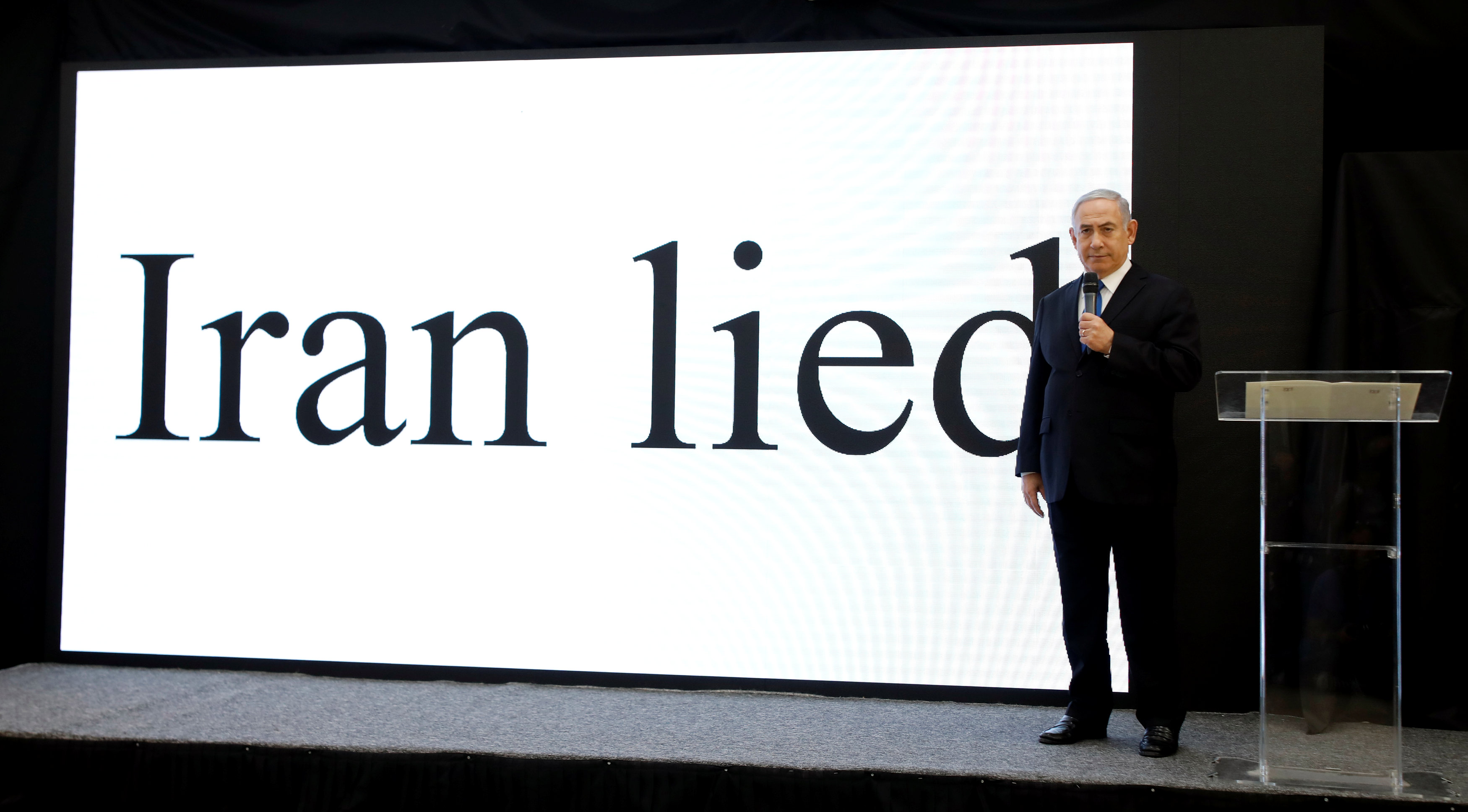
In a televised statement on Monday night Netanyahu detailed what he said were Iranian documents that purportedly prove Iran had been developing nuclear arms before the 2015 deal that it signed with the U.S. and world powers. [L8N1S7531]

On Tuesday Netanyahu told CNN that “nobody” sought a conflict with the Islamic Republic, a prospect seen by some as a possible result of the deal’s collapse.

Asked if Israel is prepared to go to war with Tehran, Netanyahu said: “Nobody’s seeking that kind of development. Iran is the one that’s changing the rules in the region.”

Israeli Prime minister Benjamin Netanyahu speaks during a news conference at the Ministry of Defence in Tel Aviv, Israel April 30, 2018. REUTERS/ Amir Cohen

Israeli Prime minister Benjamin Netanyahu speaks during a news conference at the Ministry of Defence in Tel Aviv, Israel April 30, 2018. REUTERS/ Amir Cohen

But Netanyahu’s presentation said the evidence showed Iran lied going into the deal, a landmark agreement seen by Trump as flawed but by European powers as vital to allaying concerns that Iran could one day develop nuclear bombs.

Tehran, which denies ever pursuing nuclear weapons, dismissed Netanyahu as “the boy who cried wolf,” and called his presentation propaganda.

“We warn the Zionist regime and its allies to stop their plots and dangerous behaviors or they will face Iran’s surprising and firm response,” Iranian Defense Minister Amir Hatami was quoted as saying by Tasnim on Tuesday.

Hatami called Netanyahu’s accusations “baseless”.

International and Israeli experts said Netanyahu had presented no evidence Iran was in breach of the deal. Rather, it appeared the presentation, delivered almost entirely in English, was composed as an Israeli prelude to Trump quitting the accord.

Tzachi Hanegbi, Israeli minister for regional development and a Netanyahu confidant, said the presentation was meant to provide Trump with the grounds to bolt the deal.

“In 12 days a huge drama will unfold. The American president will likely pull out of the deal,” Hanegbi said in an interview to Israeli Army Radio. “What the prime minister did last night, was to give Trump ammunition against the European naiveté and unwillingness regarding Iran.”

Under the deal struck by Iran and six major powers Tehran agreed to limit its nuclear program in return for relief from U.S. and other economic sanctions.

Trump gave Britain, France and Germany a May 12 deadline to fix what he views as the deal’s flaws – its failure to address Iran’s ballistic missile program, the terms by which inspectors visit suspect Iranian sites, and “sunset” clauses under which some of its terms expire – or he will reimpose U.S. sanctions.

The senior Israeli official said Israel knew about the Iranian archive for a year, got hold of it in February and informed Trump about it at a meeting in Washington on March 5.

REVIEW

Israel had updated China on its Iran material and by the end of this week was scheduled to host experts from Britain, Germany and France who would inspect it, the senior official said.

Most of the purported evidence Netanyahu presented dated to the period before the 2015 accord was signed, although he said Iran had also kept important files on nuclear technology since then, and continued adding to its “nuclear weapons knowledge”.

Although the presentation was live on Israeli television, Netanyahu made clear his audience was abroad, delivering most of his speech in English, before switching to Hebrew.

A 2007 U.S. National Intelligence Estimate judged with “high confidence” that Tehran halted its nuclear weapons program in the fall of 2003. The IAEA later reached a similar judgment.

One Vienna-based diplomat who has dealt with the IAEA for years, when asked what he made of Netanyahu’s speech, said: “Nothing new. Theatrics.”

EU foreign policy chief Federica Mogherini said Netanyahu did not question Iran’s compliance with the deal. She noted the deal was made “exactly because there was no trust between the parties, otherwise we would not have required a nuclear deal to be put in place”.

Hanegbi acknowledged Netanyahu had not shown Iran had violated the agreement: “The Iranians are clean in regard to the nuclear deal because it is a gift given to them by an exhausted, tired, naive world.”

An Israeli official familiar with Netanyahu’s telegenic style – one the Israeli leader has refined over decades in the international arena – said that the two-word headline “Iran Lied” that appeared beside him during the presentation was tailor-made for Trump’s own short, pithy, rhetorical style.

Noting Trump’s own use of short epithets, the Israeli official said Trump “responds to pithy messaging, and that is what we were going for with this briefing.”

(Writing by Maayan Lubell; Additional reporting by Dan Williams in Jerusalem, François Murphy in Vienna, Mark Heinrich in London, Alastair Macdonald in Brussels, Bozorgmehr Sharefedin in London, Editing by William Maclean)

Migrants from caravan in limbo as U.S. says border crossing full

A group of members of a migrant caravan from Central America and their supporters look through the U.S.-Mexico border wall at Border Field State Park before making an asylum request in San Diego, California, April 29, 2018. REUTERS/Lucy Nicholson

By Delphine Schrank

TIJUANA, Mexico (Reuters) – About 50 people from a Central American migrant caravan including women, children and transgender individuals tried to seek U.S. asylum on Sunday but were not allowed to cross the Mexico border because officials said the facility was full.

Wearing white arm-bands to distinguish themselves from others crossing at the San Ysidro checkpoint near San Diego, some of the asylum seekers waved good-bye to family members who made a difficult decision to stay behind in Mexico.

About 20 people in the group were able to reach the final fence at the busy crossing, where they were watched by armed U.S. border guards who did not immediately open the gate.

“We have reached capacity at the San Ysidro port of entry,” said Customs and Border Patrol (CBP) Commissioner Kevin McAleenan in a statement on Sunday, adding that the immigrants “may need to wait in Mexico.”

It was not immediately clear whether the group would be turned back or allowed in later. By sunset the tired migrants had decided to hunker down there, apparently with no bedding beyond the scant possessions they had with them.

Members of a caravan of migrants from Central America climb up the border fence between Mexico and the U.S., as a part of a demonstration prior to preparations for an asylum request in the U.S., in Tijuana, Mexico April 29, 2018. REUTERS/Edgard Garrido

Members of a caravan of migrants from Central America climb up the border fence between Mexico and the U.S., as a part of a demonstration prior to preparations for an asylum request in the U.S., in Tijuana, Mexico April 29, 2018. REUTERS/Edgard Garrido

“We’ve been waiting so long that it doesn’t really matter whether it’s today, tomorrow or when they let us in,” said Irineo Mujica, director of Pueblo Sin Fronteras, an advocacy group that organized the caravan since its starting point in southern Mexico a month ago.

At one point in early April the caravan gathered 1,500 immigrants from Honduras, Guatemala and El Salvador. It has drawn the wrath of President Donald Trump, who ordered immigration officials to be zealous in enforcing rules to stop unlawful entry by caravan members.

More migrants from the caravan, which numbered around 400 people by the time it reached Tijuana, also planned to seek asylum. About 100 set up an open air camp in a small square on the Mexican side by the San Ysidro pedestrian bridge, saying they would stay there until they were allowed through.

With no shelter, they laid out towels and blankets on the cold concrete.

“I’M NERVOUS. I’M AFRAID”

The mood was somber following a grueling 2,000-mile (3,200-km) trek to the border. U.S. immigration lawyers had warned the migrants of the low odds for winning asylum and the likelihood of detention, separation from relatives and deportation.

“I’m nervous. I’m afraid,” said Linda Sonigo, 40, walking solemnly toward the U.S. gate with her two-year-old granddaughter in her arms. “I’m afraid they’ll separate us,” she said, motioning to her two children and grandchild.

U.S. officials do not usually separate children from parents seeking asylum, although immigration advocates have reported instances of it happening. Families often spend less time in detention than other groups.

After U.S. border officials said the check point was full, organizers of the caravan put forward what they called the “most vulnerable cases” to cross the border first, including children under threat and transgender people who say they face persecution in Central America.

Sonigo said her family was fleeing gang violence in El Salvador. Others in the group who decided their cases were not strong enough to have a good shot at asylum tearfully said farewell to relatives they may not see again for years.

Asylum seekers must demonstrate a well-founded fear of persecution at home, and the overwhelming majority of those from Central America are denied refuge in the United States.

After making a claim, asylum seekers are usually kept in detention centers. Women with young children generally spend less time locked up and are released to await their hearings.

People in Mexico climb the border wall fence as a caravan of migrants and supporters reached the United States-Mexico border near San Diego, California, U.S., April 29, 2018. REUTERS/Mike Blake

People in Mexico climb the border wall fence as a caravan of migrants and supporters reached the United States-Mexico border near San Diego, California, U.S., April 29, 2018. REUTERS/Mike Blake

Those denied asylum are generally deported to their home countries.

Death threats from local gangs, the murder of family members, retaliatory rape and political persecution prompted members of the caravan to flee, members of the group have told Reuters.

McAleenan said the border patrol would communicate with Mexican authorities about capacity at San Ysidro, a move reminiscent of an ad hoc system created to manage an influx of Haitians two years ago, when the U.S. border agency set daily quotas for immigration interviews.

U.S. Secretary of Homeland Security Kirstjen Nielsen said earlier this week that the caravan migrants should seek asylum in Mexico.

U.S. border authorities said Saturday that some people associated with the caravan had already been caught trying to slip through the fence and encouraged the rest to report to authorities.

(Reporting by Delphine Schrank; writing by Frank Jack Daniel; editing by Phil Berlowitz, Cynthia Osterman and Darren Schuettler)

Missiles ‘will be coming’ to Syria, Trump warns Russia

A man walks with his bicycle at a damaged site in the besieged town of Douma, Eastern Ghouta, in Damascus, Syria March 30, 2018. REUTERS/Bassam Khabieh

By Susan Heavey, Makini Brice and Tom Perry

WASHINGTON/BEIRUT (Reuters) – U.S. President Donald Trump warned Russia on Wednesday of imminent military action in Syria over a suspected poison gas attack, declaring that missiles “will be coming” and lambasting Moscow for standing by Syrian President Bashar al-Assad.

Trump was reacting to a warning from Russia on Tuesday that any U.S. missiles fired at Syria over the deadly assault on a rebel enclave would be shot down and the launch sites targeted.

“Russia vows to shoot down any and all missiles fired at Syria. Get ready Russia, because they will be coming, nice and new and ‘smart!’,” Trump wrote in a post on Twitter.

“You shouldn’t be partners with a Gas Killing Animal who kills his people and enjoys it!” Trump tweeted, referring to Moscow’s alliance with Assad.

In response, Russia’s Foreign Ministry said in a Facebook post that “smart missiles should fly towards terrorists, not towards the lawful government”.

Foreign Ministry spokeswoman Maria Zakharova said any U.S. missile strike could be an attempt to destroy evidence of the reported gas attack in the Syrian town of Douma, for which Damascus and Moscow have denied any responsibility.

In Damascus, the foreign ministry accused the United States, which has supported some rebel groups in the Syrian civil war, of using “fabrications and lies” as an excuse to hit its territory.

“We are not surprised by such a thoughtless escalation by a regime like the United States regime, which sponsored terrorism in Syria and still does,” the state news agency SANA cited an official source in the ministry as saying.

After the Douma attack, the insurgent group dug in there – Jaish al-Islam – finally agreed to withdraw. That sealed a major victory for Assad in the war, crushing a protracted rebellion in the eastern Ghouta region near the capital Damascus.

White House officials did not immediately reply to a Reuters request for more detail about Trump’s remarks. The U.S. Defense Department said it “does not comment on potential future military actions”.

Trump’s decision to disclose his decision to strike as well as the kind of weaponry to be used in a future military operation is likely to frustrate military planners, who hold such information closely.

He had repeatedly said he would not telegraph military moves toward foes, including North Korea and Islamic State. On Monday Trump said he would make a decision within 48 hours on a strong, forceful response to the attack in Syria, later telling reporters: “When I will not say, because I don’t like talking about timing.”

43 DEAD FROM CHEMICAL WEAPONS EXPOSURE -WHO

The World Health Organization said on Wednesday that 43 people had died in Saturday’s attack on Douma from “symptoms consistent with exposure to highly toxic chemicals”, and more than 500 in all had been treated.

Moscow’s threat to down U.S. missiles came from its ambassador to Lebanon, Alexander Zasypkin, who said he was referring to a statement by President Vladimir Putin and the Russian armed forces chief of staff.

Zasypkin also said that any hostilities with Washington should be avoided and Moscow was ready for negotiations.

But his remarks could raise fears of direct conflict for the first time between major powers backing opposing sides in Syria’s protracted civil war.

Oil prices hit their highest level in more than three years on Wednesday after Trump’s threat to unleash missiles, and U.S. stock index futures fell sharply over rising concern about possible Russian-U.S. conflict over Syria.

The Kremlin said earlier on Wednesday it hoped all sides involved in Syria would avoid doing anything to destabilize an already volatile situation in the Middle East, and made clear it strongly opposed any U.S. strike on Damascus.

STANDOFF

Moscow and Washington stymied attempts by each other at the United Nations Security Council on Tuesday to set up international investigations into chemical weapons attacks in Syria.

Trump canceled on Tuesday a planned trip to Latin America later this week to focus instead on talks with Western allies about possible military action to punish Assad.

Zasypkin, the Russian ambassador, made his comments to Hezbollah’s al-Manar TV. “If there is a strike by the Americans, then … the missiles will be downed and even the sources from which the missiles were fired,” he said in Arabic.

The Russian military said on March 13 that it would respond to any U.S. strike on Syria by targeting any missiles and launchers involved. Russia is Assad’s most powerful ally and its devastating air power has helped him wrest back large areas of territory from rebels since 2015.

Zasypkin also said a clash between Russia and the United States over Syria “should be ruled out and therefore we are ready to hold negotiations”.

MISSILE SALVO FROM MEDITERRANEAN?

Any U.S. strike is likely to involve the navy, given the risk to aircraft from Russian and Syrian air defence systems. A U.S. Navy guided-missile destroyer, the USS Donald Cook, is in the Mediterranean.

With tensions growing, pan-European air traffic control agency Eurocontrol warned airlines to exercise caution in the eastern Mediterranean due to the possible launch of air strikes into Syria over the next 72 hours.

Eurocontrol said that air-to-ground and cruise missiles could be used within that period and there could be intermittent disruptions of radio navigation equipment.

Aviation regulators have been stepping up monitoring of conflict zones since Malaysia Airlines flight MH17 was downed by a surface-to-air missile over Ukraine in 2014, killing all 298 people on board. Recent warnings have tended to be after military action has started, so Eurocontrol’s pre-emptive notice suggests a heightening of regulatory scrutiny.

Both Russia and Iran, Assad’s other main ally, have warned his enemies against military action in recent days, underlining their commitment to the Syrian government they have armed and supported through years of conflict.

Ali Akbar Velayati, the top adviser to Iranian Supreme Leader Ayatollah Ali Khamenei, said during a visit to Damascus on Tuesday that an Israeli attack on an air base in Syria earlier this week would “not remain without response”.

Members of Syrian forces of President Bashar al Assad stand guard near destroyed buildings in Jobar, eastern Ghouta, in Damascus, Syria April 2, 2018. REUTERS/Omar Sanadiki/File Photo

Members of Syrian forces of President Bashar al Assad stand guard near destroyed buildings in Jobar, eastern Ghouta, in Damascus, Syria April 2, 2018. REUTERS/Omar Sanadiki/File Photo

RISK OF “UNCONTROLLABLE ESCALATION”

On Monday, U.N. Syria peace envoy Staffan de Mistura cited the air base strike along with other recent events in Syria in a briefing to the Security Council, cautioning against a “situation of uncontrollable escalation”.

Syria’s Russian-supplied air defences shot down an Israeli F-16 jet in February during a previous bombing run against what Israel described as Iranian-backed positions in Syria.

Last year, the United States carried out strikes from two Navy destroyers against a Syrian air base after another toxic gas attack on a rebel-controlled pocket.

The U.S. and Russian militaries have sought to avoid conflict in Syria, notably last year in the Euphrates River Valley where they supported rival sides in the campaign against Islamic State militants.

However, U.S. forces in February killed or injured hundreds of Russian contractors fighting on Assad’s side during a confrontation in Deir al-Zor province.

SYMPTOMS OF POISON GAS ATTACK

The WHO said that among the more than 500 people treated for symptoms of gas poisoning in Douma, “there were signs of severe irritation of mucous membranes, respiratory failure and disruption to central nervous systems of those exposed”.

France and Britain discussed with the Trump administration how to respond to the Douma attack. Both stressed that the culprit still needed to be confirmed.

The Hague-based Organisation for the Prohibition of Chemical Weapons said Assad’s government had been asked to make necessary arrangements for an OPCW investigation team to visit shortly.

The mission will aim to determine whether banned munitions were used but not assign blame.

Despite the international revulsion over chemical weapons attacks, the death toll from such incidents in Syria is only a fraction of the hundreds of thousands of combatants and civilians killed since the war erupted in 2011.

(Additional reporting by Dahlia Nehme in Beirut, Michelle Nichols at the United Nations, Andrew Osborn and Maria Kiselyova in Moscow, Anthony Deutsch in Amsterdam, Steve Holland, Idrees Ali, Mark Hosenball and Patricia Zengerle in Washington, Jamie Freed in Singapore, Stephanie Nebehay in Geneva; Writing by Mark Heinrich; Editing by David Stamp)

With Syria in focus, Trump cancels trip to Latin America

U.S. President Donald Trump receives a briefing from senior military leadership at the Cabinet Room of the White House in Washington, DC, U.S. April 9, 2018. REUTERS/Carlos Barria

By Roberta Rampton

WASHINGTON (Reuters) – U.S. President Donald Trump has decided to cancel his first official trip to Latin America this week to focus on responding to a suspected chemical weapons attack in Syria, the White House said on Tuesday.

Trump had been scheduled to travel to Lima, Peru, on Friday to attend the Summit of the Americas and then travel on to Bogota, Colombia. The trip had been expected to be tense and awkward because of Trump’s repeated disparagement of the region over immigration, narcotics and trade.

His travel plans changed after a Saturday night attack on the Syrian town of Douma which killed at least 60 people and injured more than 1,000 others. Trump has vowed to make a swift decision to respond to what he called “atrocities.”

“At the president’s request, the vice president will travel in his stead. The president will remain in the United States to oversee the American response to Syria and to monitor developments around the world,” White House press secretary Sarah Sanders said in a statement.

Last year, Washington bombed a Syrian government air base after a chemical weapons attack. It was not yet clear what decision Trump will make in response to the latest attack. Syria and Russia have denied there was a chemical weapons attack and have proposed international inspections.

This will be the second trip to the region for Vice President Mike Pence. He met with leaders in Colombia, Argentina and Panama in August.

(Reporting by Roberta Rampton; Writing by Doina Chiacu; Editing by Chizu Nomiyama and Jonathan Oatis)

Some 200 migrants in Mexico caravan to seek U.S. asylum: organizers

Central American migrants, moving in a caravan through Mexico, gesture as they arrive from Puebla city to La Casa del Peregrino, a temporary shelter set up for them by the Catholic church in Mexico City, Mexico April 9, 2018. REUTERS/Edgard Garrido

By Delphine Schrank

MEXICO CITY (Reuters) – At least 200 Central American migrants in a “caravan” traveling through Mexico that provoked the ire of U.S. President Donald Trump plan to seek asylum in the United States, organizers said on Monday.

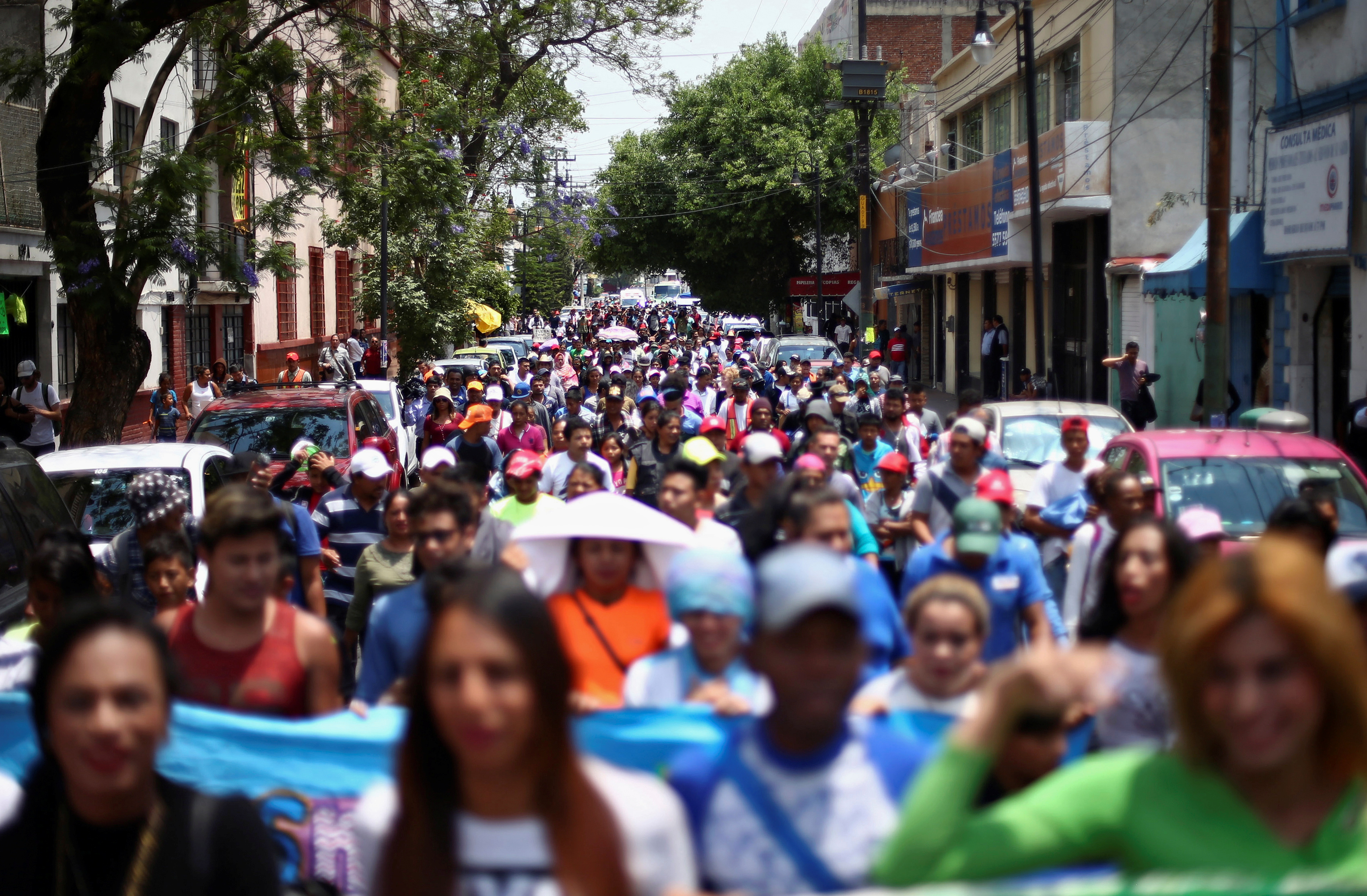
After arriving in Mexico City on Monday, hundreds of migrants poured into the Basilica of Guadalupe, a Roman Catholic shrine, to give thanks, collect themselves or unleash emotions coiled tight during their long journey together from the southern border.

The number looking to claim U.S. asylum was more than double what organizers had anticipated, said Rodrigo Abeja, a coordinator from Pueblo Sin Fronteras, a transnational organization that staged the caravan.

Central American migrants, moving in a caravan through Mexico, march from La Casa del Peregrino, a temporary shelter set up for them by the Catholic church, to the Basilica of Our Lady of Guadalupe in Mexico City, Mexico April 9, 2018. REUTERS/Edgard Garrido

Central American migrants, moving in a caravan through Mexico, march from La Casa del Peregrino, a temporary shelter set up for them by the Catholic church, to the Basilica of Our Lady of Guadalupe in Mexico City, Mexico April 9, 2018. REUTERS/Edgard Garrido

For many, the arduous trek to the capital began days or weeks before, each hinging on a personal decision to flee conditions too difficult to bear in El Salvador, Guatemala or Honduras.

Barely across the cathedral’s threshold, dozens fell to their knees, heads bowing or eyes glistening as they gazed across the vaulted expanse and strained to hear a priest leading them in prayer.

Honduran Misael George beamed, grateful to have made it this far, and said that after the service he would meet with the other migrants who wanted to seek asylum in the United States.

With his three children and his wife, he went on the run from Honduras after a close relative was killed by a gang, and the threat spread to his family, he said. But with no proof on paper, he knew his odds for claiming asylum were long.

“Difficult, yes,” he said. “But not impossible.”

Trump last week lashed out at the caravan, accusing Mexico of failing to stop illegal immigrants headed to the border.

Manuel de Jesus Rodas, 27, from Honduras, daubed his tears with a tissue but could not staunch the emotion that choked his voice. His mother had just told him to come home, he said, because she was sick and in pain.

Now he waited for guidance about whether to go home – or go on. “I don’t know, but I think I have to follow my route,” he said.

Others in the caravan said they would stay in Mexico.

(Editing by Cynthia Osterman)